
Client Approval Workflow for Social Media Agencies (2026 Playbook)
Approval is where agency margin lives or dies. A well-run approval workflow keeps the team shipping. A broken one means content sits in Slack threads, clients drift on commitments, and post dates slip into next sprint. This is the playbook our highest-output agency users actually run.
Why agency approval breaks
Approval breaks for the same three reasons across every agency we have talked to: no defined chain, no version control, and no concept of reopening. Without these three primitives, every client becomes a special case and every special case eats hours.
The good news: solving all three is mostly a tool problem, not a process problem. The right tool encodes the chain, tracks the versions, and supports reopen-after-signoff out of the box. The rest is just discipline.
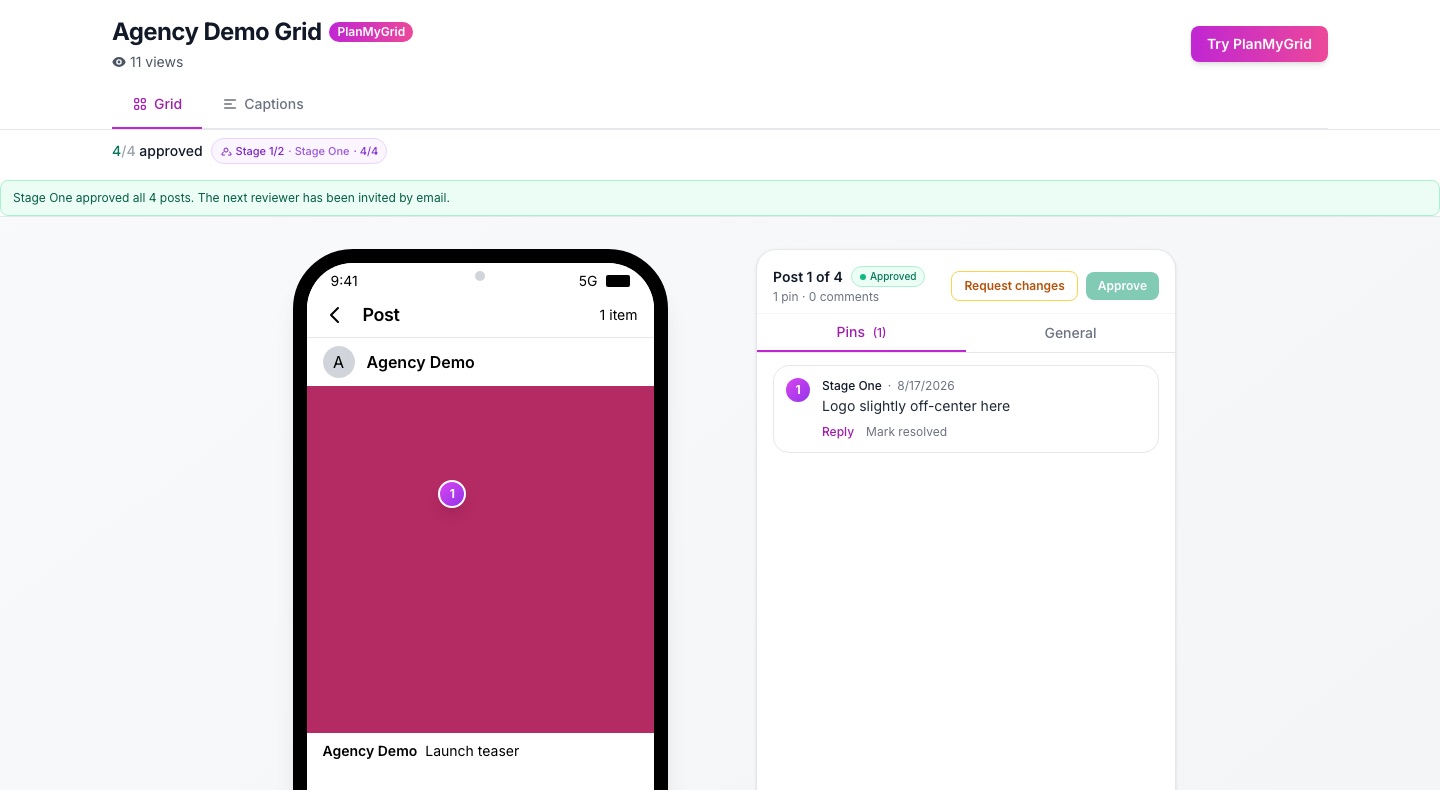
Try the playbook: Spin up a free PlanMyGrid trial and configure a 3-stage reviewer chain on your first grid. Move to the Agency tier when you are ready to white-label the client view.
The three stages
Every agency we have audited runs some variant of this three-stage chain. The stage names change. The shape does not.
Stage 1 — Internal review
Designer or content strategistPurpose: First-pass quality check. Did we hit the brief? Are captions on brand voice? Are visuals consistent with the grid?
Common pitfalls
- • No defined reviewer — content drifts to whoever has time
- • Reviewer also wrote it, so blind spots compound
- • No time-box, internal review takes 2 days for what should be 2 hours
Stage 2 — Account manager check
AM or strategistPurpose: Strategy and tone alignment. Does this match the campaign theme? Are we breaking any client-specific rules (banned words, off-message offers)?
Common pitfalls
- • AM only sees a Slack screenshot, not the full grid context
- • Decisions live in DMs, not the planning tool
- • If AM is on PTO, content stalls
Stage 3 — Client sign-off
Client point of contactPurpose: Final approval before scheduling. Client looks at the post in grid context, approves, requests edits, or rejects.
Common pitfalls
- • Client receives 14 emails, opens 2
- • Login walls cause silent abandonment
- • Client approves verbally on a call but never signs off in the tool — version drift
- • Client requests edits after sign-off; the system has no concept of reopening
Tool requirements
Here is what to demand from your planner if you want this workflow to run without drama.
Reviewer chains (sequential, not all-at-once)
Stage 1, 2, 3 must happen in order. If client sees content before internal QA, you waste their time and your credibility. If they see it at the same time as internal, comments collide.
Versions
When a reviewer requests edits, the next version must be tracked. You need to know which version the client signed off on — not just 'the latest one'.
Reopen-after-signoff
Real agency life: a client signs off, then 12 hours later sends a 'wait, can we change the second slide?' email. Your tool must support reopening a signed-off post without losing the audit trail.
No-login client review
Login walls are the largest cause of approval delays. A client clicks an email link, gets a login screen, and gives up. Per-post approval via shareable link should be the default.
Email digest
Clients hate one email per post. A daily digest with all pending items is faster and far more likely to get acted on.
Approval cycle time analytics
If you cannot measure cycle time per client, you cannot fix it. The two clients eating 80% of your team's time are the ones holding everyone hostage at the sign-off stage.
Pitfall: lost emails
The single biggest source of approval delay in 2026 is "the email went to spam." If your tool sends approval emails from noreply@vendor.com without a properly authenticated SPF, DKIM, and DMARC, those emails land in promotions or spam. Clients then claim they never got it. Two days lost.
On Studio and Agency tiers, PlanMyGrid sends approval mail from your own domain via a per-tenant Resend sender. That single change measurably cuts "I didn't see your email" complaints.
Pitfall: version drift
Version drift happens when the same post is being edited in three places: the planner, a Notion doc, and the designer's desktop. By the time it reaches the client, nobody is sure which caption is the canonical one.
The fix: make the planner the single source of truth, and use a tool with real-time collaboration so the designer and the AM are looking at the same document. PlanMyGrid uses a Yjs CRDT — same technology as Google Docs — so two people editing the same post never conflict.
Pitfall: no concept of reopen
Most tools treat sign-off as a terminal state. Once approved, content moves to scheduled and that is it. But agencies live in a world where clients change their minds. Without a reopen flow, you end up cloning the post, deleting the old one, losing comment history, and confusing the team about which version is real.
On PlanMyGrid Studio and Agency, owners can reopen a signed-off post. The system creates a new version, preserves the original sign-off in the audit log, and routes the post back through the chain. The client sees a clear "v2 — pending approval" state. No confusion, no lost history.
Sample reviewer chain configurations
Here is how to set up reviewer chains for three common agency archetypes:
| Client type | Chain | Notes |
|---|---|---|
| Trusting SMB | Designer → Client | One internal pass, fast cycle |
| Mid-market brand | Designer → AM → Client | The default 3-stage chain |
| Regulated enterprise | Designer → AM → Legal → Brand → Client | 5-stage with parallel legal/brand stages |
PlanMyGrid Agency supports up to 6-stage chains and per-client templates so onboarding a new brand is a 30-second clone rather than a full setup.
How to measure if it works
- • Approval cycle time: hours/days from share to sign-off, by client. Track in a benchmark dashboard. Cycle-time benchmark guide.
- • Reopen rate: how often signed-off content gets reopened. High reopen rate signals weak earlier stages.
- • Stage drop-off: which stage do most posts get stuck in. Almost always client.
- • Email open rate: if it is below 60%, your sender domain or subject line is broken.
Frequently Asked Questions
What is a reviewer chain in agency content approval?
A reviewer chain is a sequence of approvers who must sign off in order — typically internal reviewer, then account manager, then client. Each stage gates the next. This prevents internal quality issues from leaking to the client and prevents premature client review of half-finished work.
How do you handle client edits after sign-off?
Use a tool that supports 'reopen-after-signoff'. PlanMyGrid lets the owner reopen a signed-off post, which moves it back to the requested-changes state, captures the new version, and preserves the original sign-off in the audit log. Tools without reopen force you to delete and recreate, losing history.
Should each client have their own approval rules?
Yes. Some clients want one-touch approval. Some want legal review. Some require a dual sign-off (marketing director + brand director). Your tool should let you configure per-client reviewer chains rather than forcing a single global workflow.
What is a healthy approval cycle time for an agency?
There is no published industry dataset for this yet, so treat these as operating targets rather than measured medians. Internal-to-AM review should land inside 24 hours. Client sign-off is the long pole — anywhere from same-day to 5 business days depending on client engagement. The agencies with the lowest churn measure cycle time per client and surface the laggards in weekly QBRs rather than absorbing the cost silently.
Ship the playbook this week
PlanMyGrid Agency ships reviewer chains, versions, reopen-after-signoff, daily digest, and cycle-time analytics — the exact stack this playbook calls for, at $129/mo.